
Engineering Health Radar
Overview
The Problem
Engineering leaders often operate with fragmented signals. Jira says delivery is green, GitHub shows blocked pull requests, incident history tells a different story, and team health is hidden in meetings and Slack threads.
The result is “watermelon reporting”: work looks green from a distance, but a closer look reveals unmanaged risk, slow flow, poor readiness, or governance gaps.
The Solution
The Engineering Health Radar is a leadership dashboard pattern that brings together delivery, quality, risk, flow, and governance signals into one operating view.
It is designed to help engineering managers move from status collection to intervention: identifying bottlenecks, weak signals, readiness gaps, and improvement opportunities before they become delivery failures.
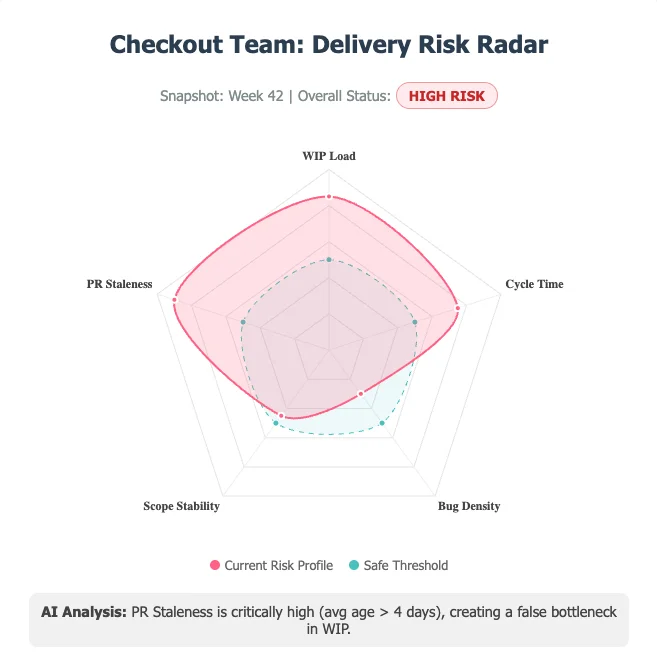
Signal Model
- Delivery: throughput, lead time, cycle time, roadmap confidence, dependency risk.
- Quality: defect trends, test evidence, review latency, rework, production escape signals.
- Flow: WIP, blocked work, ageing work, handoff delays, queue time.
- Reliability: incident rate, MTTR, change failure indicators, release readiness.
- Governance: missing approvals, policy exceptions, audit gaps, security scan status.
Leadership Angle
The value is not another dashboard. The value is a better management rhythm.
The radar gives engineering leaders a factual basis for coaching, release planning, stakeholder communication, and delivery trade-offs. It turns scattered operational data into practical questions:
- Where is work slowing down?
- Which teams are carrying unmanaged risk?
- Which releases lack evidence?
- Which governance failures are systemic rather than one-off mistakes?
- Which intervention would improve flow without creating churn?
What This Proves
- Engineering management can be evidence-led without becoming metric theatre.
- AI-assisted analysis is most useful when it explains delivery risk and recommends targeted action.
- Delivery intelligence should connect flow, quality, reliability, and governance rather than treating them as separate reporting streams.
Project Status
This project is in-progress.